Modified Method of Feasible Directions (MMFD) Technique | ||
| ||
The Modified Method of Feasible Directions technique has the following features:
rapidly obtains an optimum design,
-
handles inequality and equality constraints, and
-
satisfies constraints with high precision at the optimum.
The sequence of steps followed by the MMFD technique are as follows:
- ,
- Evaluate (
 ) and ();
- Identify the set of critical constraints,
- Calculate
- Determine the usable/feasible search directions,
- Perform 1D search to find a*
- Set
- Check for convergence; if not converged, go to Step 2.
The MMFD technique uses one of the following methods to find the search direction at each iteration q:
- If no constraints are active or violated, the (previously described) unconstrained Conjugate Gradient method is used.
- If any constraints are active and none are violated, the MMFD technique minimizes
subject to:
.
-
If one or more constraints are violated, the MMFD technique
minimizes
subject to:
where
is the set of active and violated constraints
is a large positive number
is a push-off factor for constraints
= 0 for active constraints
> 0 for violated constraints
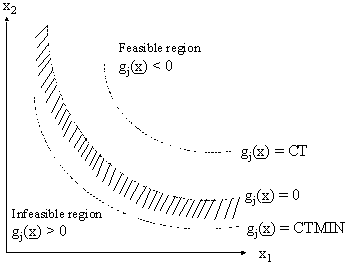
The active and violated constraints are identified as follows:
is active, if
is violated, if
Active and Violated Constraint Identification