T1: Plane stress elements—membrane with hot-spot | ||
| ||
ProductsAbaqus/Standard
Elements tested
CPS3
CPS4
CPS4I
CPS4R
CPS6
CPS6M
CPS8
CPS8R

Problem description
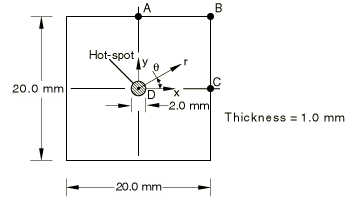
Material:
Linear elastic, Young's modulus = 100 GPa, Poisson's ratio = 0.3.
Boundary conditions:
A quarter-section is modeled with the symmetry conditions 0 along 0 and 0 along 0.
Loading:
Within the hot-spot, thermal strain () = 1.0 × 10⁻³. Outside the hot-spot, thermal strain () = 0.
Reference solution
This is a test recommended by the National Agency for Finite Element Methods and Standards (U.K.): Test T1 from NAFEMS publication TNSB, Rev. 3, “The Standard NAFEMS Benchmarks,” October 1990.
Target solution: at point D (outside the hot-spot) = 50.0 MPa.
Results and discussion
The results are shown in the following table. The values enclosed in parentheses are percentage differences with respect to the reference solution.
| Element | at D |
|---|---|
| CPS3 | 54.25 MPa (8.4%) |
| CPS4 | 50.94 MPa (1.9%) |
| CPS4I | 46.29 MPa (−7.4%) |
| CPS4R | 23.65 MPa (−52.7%)* |
| CPS6 | 54.46 MPa (8.9%) |
| CPS6M | 54.25 MPa (8.5%) |
| CPS8 | 51.53 MPa (3.1%) |
| CPS8R | 44.06 MPa (−11.9%)* |
*A comparison of the results for reduced-integration and full-integration elements indicates that the full-integration elements perform significantly better for problems with stress concentrations of this type.
Input files
- nt1xxf3x.inp
-
CPS3 elements.
- nt1xxf4x.inp
-
CPS4 elements.
- nt1xxf6x.inp
-
CPS6 elements.
- nt1xxf8x.inp
-
CPS8 elements.
- nt1xxi4x.inp
-
CPS4I elements.
- nt1xxm6x.inp
-
CPS6M elements.
- nt1xxr4x.inp
-
CPS4R elements.
- nt1xxr8x.inp
-
CPS8R elements.